Exposure Management
10 Min

Beyond Mythos - The CISO Playbook for AI-Enabled Adversaries

NetSentries  ·  CISO Playbook — May 2026
Beyond
Mythos

The CISO Playbook for AI-Enabled Adversaries

Claude, GPT, Gemini, and the broader frontier model cycle have fundamentally changed what attackers can do and have unsettled boardrooms globally. This playbook provides CISOs with a structured response framework covering real industry developments, emerging risks, and the strategic pillars required to close the operational security gap.

00
Introduction
The frontier model mythos, the panic it has caused, and what to actually do

The emergence of frontier AI models such as Anthropic's Claude series, OpenAI's GPT models, Google's Gemini models, and increasingly autonomous agentic AI systems has created genuine concern in C-suites globally. The concern is rational, and the response must be structured.

By mid-2026, CISOs are repeatedly being asked the same questions in boardrooms: How do frontier AI models change our threat model? What does the next generation of AI capability mean for our security program? Are we prepared for AI-assisted and agentic attacks?

The accelerating cadence of frontier model releases since 2023, combined with visible capability improvements across reasoning, coding, automation, and autonomous task execution, has fundamentally changed how leaders perceive cyber risk. At the same time, operational evidence of AI-assisted reconnaissance, social engineering, malware development, vulnerability research, and attack automation has accumulated faster than most enterprise security programs have adapted.

Cybersecurity is being reshaped, not eliminated.

The eight pillars in this playbook are evolutions of existing disciplines, strengthened at the points where frontier models such as Claude, GPT, Gemini, Llama, and DeepSeek have changed attacker economics.

What the mythos tells your board

The Claude Mythos and similar frontier models have reset the perception of cyber risk at the C-suite level. The concern is warranted. The response must be structured.

"The frontier model wave will end cybersecurity as a function. We need to rebuild from scratch."

What is actually true in 2026

Agentic AI is already operational on both sides. AI coding agents, browser agents, enterprise copilots, and open agent frameworks can now execute multi-step tasks with limited human input. Attackers are using the same shift to accelerate reconnaissance, vulnerability research, exploit development, social engineering, and attack automation.

The defensive answer is not to wait for regulatory clarity. It is to instrument and govern agentic capability on the defensive side through AI-augmented SOC operations, incident response copilots, secure automation, and autonomous exposure validation.

"Agentic AI is the next existential threat. We have years to respond."

What is actually happening
Frontier developments reshaping cybersecurity in 2026

Frontier model release cadence has not slowed. At the same time, the rise of AI-generated software and "vibe coding" has created a new software supply chain risk: applications are being built and shipped faster than they can be properly reviewed, tested, and governed. Traditional security tooling alone is not enough to cover this gap.

The EU AI Act came into force in stages from August 2024 and has been actively enforced through 2025 and 2026. NIST AI RMF and ISO 42001 are now treated as audit baselines, and major cyber insurance carriers added AI governance attestations to standard underwriting in 2025. Regulation is no longer a future planning exercise. On the vendor's side, an AI logo on a datasheet does not change what the product actually does. A signature-based WAF still misses polymorphic LLM-generated payloads. SMS and push MFA still fall to Evilginx-style AiTM kits. Insist on independent validation before believing a claim.

Frontier AI development has continued at an aggressive pace. Claude, GPT, Gemini, Llama, DeepSeek, Mistral, and other frontier models have rapidly advanced reasoning, coding, automation, and autonomous task execution capabilities. Security teams should increasingly treat major frontier model releases as events that may materially alter attacker capability and defensive assumptions.

"AI safety frameworks and regulations will catch up. Our existing tools already cover this."

What the market often overlooks

The boardroom narrative is that frontier AI will replace cybersecurity as a discipline. It will not. What is changing is the speed, scale, and economics of both attack and defense.

The organizations that adapt successfully will not necessarily be the ones with access to the most advanced model, but the ones with the strongest operational discipline, governance, visibility, validation, and response capability.

The role of the modern CISO is to operationalize frontier AI safely on the defensive side faster than adversaries operationalize it for attack. This playbook provides a practical structure to help achieve that.

The panic to ground

The narrative is amplified because fear sells platforms, subscriptions, and consulting services. In reality, both adversaries and defenders now have access to increasingly capable frontier AI systems. Once capabilities become available through open-weight models and public tooling, they rapidly become accessible to attackers as well.

Agentic AI moved from demo to production

Agentic AI has moved from experimentation into operational use on both the offensive and defensive sides. Organizations should prepare for adversaries using semi-autonomous workflows capable of executing reconnaissance, phishing, vulnerability research, exploit chaining, and operational decision-making with limited human involvement.

Vibe coding became a real supply chain risk

AI-generated software development, often referred to as "vibe coding," has introduced a growing software supply chain and assurance challenge. Applications, scripts, APIs, and dependencies are now being generated and deployed faster than traditional review and security validation processes can reliably assess them.

Open-weight model proliferation is permanent

Open-weight frontier models have permanently changed accessibility to advanced AI capability. Once advanced reasoning, coding, or automation capabilities become broadly available through open ecosystems, defenders must assume similar capabilities are accessible to adversaries as well.

Regulation moved from aspiration to enforcement

AI governance has shifted from future planning to operational and regulatory reality. The EU AI Act is being applied in phases, while frameworks such as NIST AI RMF and ISO/IEC 42001 are increasingly influencing governance, procurement, assurance, and audit expectations.

Security disciplines have matured

Disciplines such as CTEM, Adversarial Exposure Validation (AEV), AI-augmented security operations, FIDO2 adoption, defensive automation, and frontier-model-assisted code review have matured significantly between 2023 and 2026, moving from emerging concepts into measurable enterprise adoption.

01
The Shift
Why yesterday's defenses will not survive tomorrow's adversary

Two assumptions ran enterprise defense for twenty years. First, finding flaws was hard. Second, turning a flaw into a working exploit was harder still. Both are now wrong. AI-augmented adversaries chain reconnaissance, exposure discovery, payload generation, and exploitation inside a single workflow. The window between a fresh finding and a working exploit has collapsed from weeks to hours. For the most capable actors, to minutes.

The CISO objective has shifted with it. The job is no longer to prevent discovery. That race is lost. The job is to limit exposures, accelerate validation, and shorten the time between adversary discovery and defender remediation. This playbook does that work in eight strategic pillars and eight operational domains. Each pillar carries the reasoning behind the recommendation, so the same case can be made to a board, to an engineering team, and to a procurement committee.

< 24h
Median time from CVE publication to mass exploitation
Increase in attacks per asset since frontier AI tooling became commodity
82%
Of breaches involve an exposure that was externally visible for over 30 days

Directional figures consolidated from public incident response reporting.

Then · pre-2023
Weeks
Now · 2026
Hours → minutes
Discovery
Recon
Payload
Exploit
Compromise

The exploit timeline, then and now. Patch SLAs measured in weeks no longer fit internet-facing assets.

Every exposure should now be planned against as if it is already weaponized

Prioritize, validate, and respond against that assumption. Patch SLA arithmetic from the previous era no longer fits the current threat landscape.

02
Strategic Pillar 1
Lock down sensitive non-production environments
P1 Control every sensitive environment. Staging, UAT, QA, and sandbox.
The risk. Why this matters.

Non-production environments are the soft underbelly of modern enterprises. They commonly hold real or lightly masked production data, real credentials, live integrations to third parties, and copies of the same code that runs in production. They run with weaker authentication, fewer monitoring controls, and broader access for developers, contractors, vendors, and offshore partners. They are stood up quickly, decommissioned slowly, and rarely subject to the same change control or threat monitoring discipline as production.

Attack surface management tooling, used by defenders and adversaries alike, indexes internet-exposed UAT, Staging, QA, Development, and Sandbox subdomains within minutes of them appearing. Several of the most consequential breaches of the last three years began in a sandbox, a CI runner, or a partner-shared staging environment, not in production. Treating non-production as "lower risk" is a defender bias. Attackers treat it as the lowest friction path into your data and your supply chain.

THE RECOMMENDATION
Default deny public access

No sensitive non-production environment should be reachable from the public internet. Enforce source IP allow listing at edge (CDN, WAF, or load balancer). Restrict access to corporate VPN ranges, ZTNA broker egress IPs, and named partner ranges only.

Front everything with ZTNA and phishing-resistant MFA

Replace shared VPN credentials with identity-bound ZTNA policy. Each engineer, contractor, and partner gets named, time-bound, least-privilege access. Revoke on offboarding within minutes.

Separate the identity plane

Non production identities must never carry production privileges, even transiently. A compromised developer sandbox account should never enable lateral movement to production data or pipelines.

Mask the data or treat it as production

If real PII, PHI, or financial data is required for realism, the environment inherits production-grade controls, monitoring, and audit. Otherwise, use synthetic or masked datasets.

Equal SIEM coverage

Non production environments must be logged and monitored with the same detection content as production. Attackers favor telemetry gaps. Close them.

Two paths to your staging environment. Only one survives a frontier AI enabled attacker.
Public Internet
Today · Direct exposure
staging.acme.com
ZTNA + VPN
MFA · IP allow list
Tomorrow · Identity gated, logged
Sensitive non-production
staging · UAT · QA · sandbox

Non-production environments are among the most predictable and commonly targeted initial access vectors in the AI era. They are typically less mature from a security hardening and monitoring perspective, while remaining internet-accessible in many organizations. Remediating exposures in non-production environments is significantly more cost-effective than addressing similar issues in production, with a high-risk-reduction-to-cost ratio. Every quarter these environments remain externally exposed increases the likelihood of adversaries leveraging them as an initial access pathway into the organization.

03
Strategic Pillar 2
Frontier AI for code assurance
P2 Use today's frontier models to fix flaws before tomorrow's frontier models find them.
The risk. Why this matters.

Generally available frontier AI models can already perform code review and vulnerability analysis at a depth that previously required senior security engineers. The capability frontier is advancing rapidly, and each major model release expands the range of vulnerabilities that can be identified through AI-assisted analysis of codebases.

Adversaries gain access to the same model improvements as defenders. With every new release, attackers are likely to re-audit public-facing targets, exposed repositories, and leaked source code to uncover weaknesses that were previously impractical or difficult to identify. Vulnerabilities that were not operationally exploitable yesterday may become exploitable tomorrow as model capabilities improve.

Defenders must continuously harden systems against every capability tier available to attackers, while attackers need only a single exploitable flaw to achieve compromise. Delaying code re-assessment until the next major model release effectively allows adversaries to dictate the organization's incident timeline.

THE RECOMMENDATION
Audit with the most capable frontier model you can responsibly access, now

Run every business-critical codebase, infrastructure-as-code repository, and high-trust integration through frontier model security review. Act on findings before the next public model launch.

Make "frontier model release" a security event

Add a recurring entry in your security calendar. Each new top-tier model release triggers a re-audit of crown jewel code.

Run multi-model ensembles

Different model families surface different flaw classes. A single model has blind spots. Two or three frontier models in rotation find materially more.

Layer AI on top of classical tools, not instead of them

AI-augmented SAST, DAST, SCA, and IaC scanning remain the baseline. Frontier model review catches logic flaws, chained vulnerabilities, business logic abuse, and authorization gaps that pattern-matching tools systematically miss.

Govern the assistants

Engineering AI coding assistants must be scoped, prompt-logged, and policy-gated. The same models that help your developers will help adversaries study your code.

Vulnerability finding capability
Gen N−2 Gen N−1 Gen N (today) Gen N+1 (next)
Time · Model generation
Window to pre-empt
Audit your code now with the most capable model you can run.
Flaws adversaries will find next
Model not yet released to you.

The capability curve. Defenders win the months between today's frontier model and tomorrow's by re-auditing aggressively.

Identifying a vulnerability with today's frontier AI models costs only a fraction of the financial and operational impact of incident response if an adversary discovers and exploits the same flaw using the next generation of models a few weeks later. Frontier-model-driven code assurance should therefore be treated as a proactive security investment with a measurable positive return on investment, rather than as an optional assessment activity.

04
Strategic Pillar 3
Preemptive Exposure Management (PEM)
P3 Exposure is the new exploit. Adopt PEM as the way you run security.
The risk. Why this matters.

Traditional vulnerability management was built for an era when developing a reliable exploit required weeks of skilled effort. Patch SLAs and remediation cycles were tuned to that timeline. In 2026, the assumption is inverted. Exposure increasingly approximates exploitability. AI-augmented adversaries can chain reconnaissance, exploit research, payload generation, and weaponization into a single accelerated workflow. CVSS-driven prioritization routinely pushes teams toward theoretical "high" findings while externally exposed and practically exploitable weaknesses remain unaddressed.

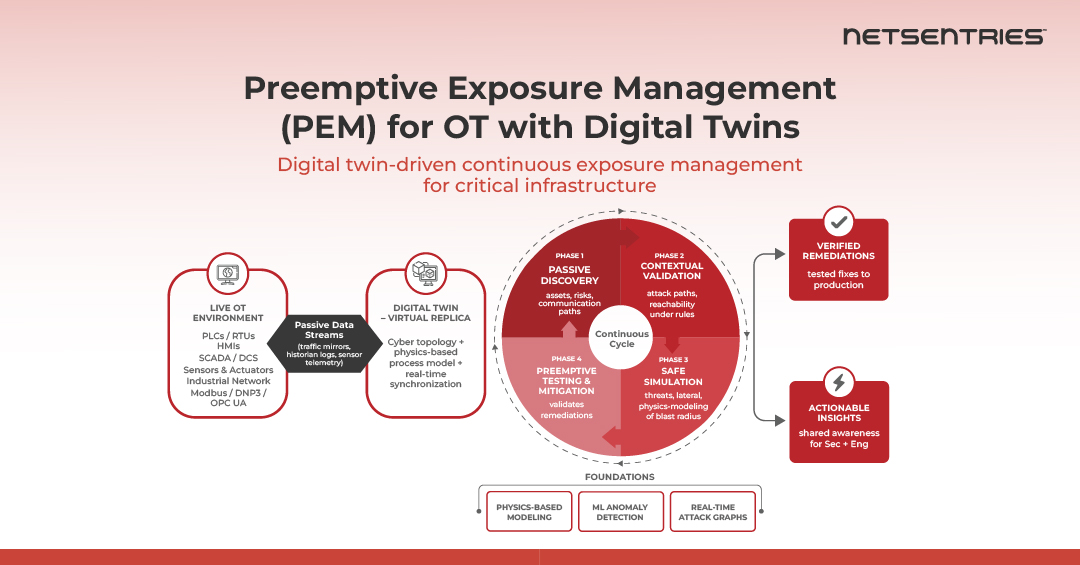
The shift, and the differentiator for mature security programs, is Preemptive Exposure Management (PEM) enabled through Continuous Threat Exposure Management (CTEM) and Adversarial Exposure Validation (AEV). CTEM replaces episodic, severity-driven vulnerability management with a continuous, exploitability-driven, business-aligned process, while AEV continuously validates whether exposures can realistically be leveraged by attackers under real-world conditions. The focus shifts from reducing vulnerability counts to proactively reducing exploitable attack surface before adversaries operationalize it.

THE RECOMMENDATION
Scope by business outcome, not by asset list

Map crown jewel processes, the systems that support them, and the identity and supply chain paths into them. Everything else is secondary.

Discover continuously, externally and internally

Pair external attack surface management with internal asset, identity, and data flow inventories to maintain continuous visibility across the environment. Implement daily drift detection to identify newly exposed assets, configuration changes, identity sprawl, and unauthorized data flow changes before they become exploitable.

Prioritize on exploitability and business impact, not on CVSS

Weight remediation decisions using active exploit intelligence, asset criticality, potential blast radius, attack path context, and identity reach to focus efforts on exposures most likely to lead to material compromise.

Validate everything that matters

Continuous Adversarial Exposure Validation (AEV), AI-augmented penetration testing, and continuous red team operations help validate which exposures are practically reachable, exploitable, and capable of leading to meaningful business impact under real-world attack conditions.

Mobilize fast

Integrate CTEM outputs directly into ticketing, change management, and incident response workflows. The primary metric should be time from confirmed exposure to verified remediation, measured in hours, rather than traditional patch cycle or SLA compliance metrics.

THE PEM OPERATING LOOP
A continuous, exploit-led process — not an annual project
SCOPE
Crown jewels
DISCOVER
External + Internal
PRIORITISE
Exploitability
VALIDATE
AEV · Red team
MOBILISE
Fix · Respond
PEM · Preemptive Exposure Management

Each lap shortens the gap between exposure and verified remediation. The CTEM cycle: continuous, exploitability led, business aligned, and tightly coupled to remediation.

Modern adversaries operationalize exposed weaknesses within hours of discovery. Periodic vulnerability management and annual penetration testing cycles increasingly fail to match the speed of attacker operations, effectively ceding the initiative to the adversary. Preemptive Exposure Management (PEM), enabled through CTEM and continuous AI-augmented validation, transforms security into a continuous validation and remediation loop aligned to real-world threat tempo and continuously evolving attack surfaces.

05
Strategic Pillar 4
Zero Trust Network Access (ZTNA)
P4 Adopt ZTNA. The corporate VPN belongs in the previous era.
The risk. Why this matters.

Corporate VPNs were designed for a workforce operating behind a trusted perimeter. They typically grant a successfully authenticated user broad network-level access or access to specific applications or services. Once credentials are compromised, through phishing, infostealer malware, session theft, MFA fatigue attacks, or criminal marketplace purchases, attackers inherit the same trust as the legitimate user. From that point, reconnaissance, lateral movement, privilege escalation, and ransomware deployment often follow as standard attack progression.

VPN concentrators also centralize risk by exposing authentication infrastructure directly to the internet. The Fortinet, Ivanti, and Citrix Gateway exploitation waves across 2023 and 2024 demonstrated how VPN appliances themselves became high-value initial access vectors. Technologies originally intended to secure remote access increasingly became one of the primary pathways used by adversaries to gain entry into enterprise environments.

ZTNA reduces this risk by replacing broad network-level trust with identity-aware, application-specific access controls based on continuous verification of user identity, device posture, location, behavior, and contextual risk. Instead of placing users directly onto the internal network, ZTNA limits access only to explicitly authorized applications and services, significantly reducing attack surface, lateral movement opportunities, and the impact of credential compromise. In the AI-augmented threat era, where credential theft and rapid exploitation are highly automated, minimizing implicit trust and network exposure is becoming a foundational security requirement rather than an architectural enhancement.

THE RECOMMENDATION
Per application, per session, per user policy

ZTNA grants access to one application at a time, not to a network. A compromised session never opens the rest of the estate.

Default deny. Explicit allow

Every request is evaluated against identity, device posture, geography, time, and risk signals before access is brokered.

Identity bound

Tie ZTNA to a strong identity provider (Microsoft Entra, Okta, Ping) with phishing-resistant MFA at the front door. Identity becomes the only authoritative trust anchor.

Continuous trust evaluation

Re-evaluate session trust at intervals and on signal changes. Drop the session when posture, location, or risk score moves.

Hide the application from the internet

Internal apps no longer publish to public DNS. Only the ZTNA broker is internet-reachable. The application is invisible to scanners.

Cover partners and contractors

Named, time-bound ZTNA access replaces shared VPN credentials and partner site-to-site tunnels for third party access.

VPN · Broad network access
user → VPN →
app 1
app 2
db
file share
backups
admin tools
CI
One credential. Full network. Lateral movement is trivial.
ZTNA · Per app access
user → ZTNA broker + IDP →
app 1
app 2 (denied)
One credential. One application. Continuous trust evaluation.

Outcome: smaller blast radius, no exposed VPN concentrator, faster offboarding, audit per app. ZTNA collapses the lateral movement surface and eliminates the "trusted internal network" assumption.

Over the last two years, numerous major breaches have demonstrated how a single compromised VPN credential or exposed VPN appliance can rapidly escalate into full network intrusion, lateral movement, and ransomware deployment. ZTNA helps break this attack chain at the architectural and protocol level by eliminating implicit network trust and restricting access to only explicitly authorized applications rather than exposing the broader internal network. The technology has matured significantly, procurement options are widely available and competitive, and in most enterprise environments the user experience is often simpler, faster, and more reliable than traditional VPN-based remote access.

06
Strategic Pillar 5
AI-resilient MFA. FIDO2 and passkeys.
P5 Move MFA from "we have MFA" to MFA that survives an AI-driven adversary.
The risk. Why this matters.

Many enterprises implemented MFA and treated it as a completed security objective. SMS OTPs, time-based one-time passwords (TOTP), and push notifications provided meaningful improvement over password-only authentication, but they are increasingly insufficient against modern attack techniques. Adversaries now routinely bypass these mechanisms at scale using adversary-in-the-middle phishing frameworks such as Evilginx and Modlishka, MFA fatigue and push bombing attacks, SIM swapping, session token theft, AI-assisted social engineering, and AI-generated phishing portals that closely mimic legitimate login pages.

As AI-driven phishing, automation, and credential theft capabilities continue to improve, authentication systems relying on reusable or interceptable factors become progressively easier to compromise. Organizations must transition toward phishing-resistant MFA approaches such as FIDO2/WebAuthn security keys, device-bound authentication, certificate-based authentication, and strong conditional access policies that validate device posture, behavioral signals, and contextual risk in real time. In the current threat landscape, simply "having MFA" is no longer a sufficient security benchmark; the resilience of the MFA implementation against modern adversary techniques is what determines actual defensive value.

THE RECOMMENDATION
FIDO2 and passkeys for the workforce

Hardware bound credentials based on WebAuthn (Yubikeys, Google Titan, platform passkeys on Apple, Google, and Microsoft devices). The private key never leaves the device. Adversary in the middle phishing fails because the credential is bound to the legitimate origin.

Hardware keys for administrators and high-risk users

Treat domain admins, finance approvers, and developers with production access as a category that requires hardware keys, not platform passkeys alone.

Retire SMS and voice as MFA factors

Keep them only as last-resort fallback with strong rate and identity proofing. SMS should not be a standing option for privileged users.

Number matching push at minimum

Where push MFA must remain, require number matching plus context (location, application). This defeats fatigue-style attacks.

Help desk hardening against AI social engineering

Identity verification must use callback to a known number, in-person verification, or a second authenticated channel. Voice alone is no longer sufficient.

Account recovery is itself phishing-resistant

The path to recover access cannot be weaker than the path to authenticate. Recovery via SMS or knowledge-based questions undoes the rest of the investment.

Defeated minimum
SMS / Voice
SIM swap. AI voice clone. Phishing.
Defeated
TOTP code
AiTM proxy (Evilginx). Real time replay.
Weak
Push approval
MFA fatigue, push bombing. Needs number match.
Strong
Platform passkey
WebAuthn, origin-bound. AiTM-resistant.
Strongest
Hardware FIDO2
Yubikey, Titan. Key never leaves the device.
GOAL · All users on FIDO2 or passkeys

MFA strength ladder. Move workforce right, retire the left.

The cost of deploying phishing-resistant authentication such as hardware security keys for privileged users is negligible compared to the operational, financial, and regulatory impact of a single administrative identity compromise. Passkeys and FIDO2-based authentication are now natively supported across major enterprise platforms, operating systems, browsers, and mobile ecosystems. Most of the historical technical barriers that delayed large-scale adoption have effectively been eliminated. The remaining challenge is primarily operational execution, including rollout planning, user onboarding, lifecycle management, and enforcement of strong authentication policies.

07
Strategic Pillar 6
AI-orchestrated WAF and dynamic cloud defense
P6 Re-arm the perimeter with AI-orchestrated, dynamic defenses.
The risk. Why this matters.

Traditional WAF architectures were designed around detection of known malicious signatures and repeatable attack payloads. That model is increasingly challenged by AI-augmented adversaries capable of generating polymorphic, context-aware payloads that dynamically adapt to application behavior and often resemble legitimate traffic patterns. Many modern attack chains only become observable after multiple stages of interaction, reducing the effectiveness of static signatures, traditional WAF rulesets, host IDS, and rigid API gateway policies. At the same time, excessive false positives continue to consume analyst capacity and reduce operational effectiveness.

The defensive response is not to abandon existing WAF investments, but to augment them with AI-driven behavioral analysis, adaptive policy enforcement, and globally correlated threat intelligence. Modern cloud-based WAF and edge security providers operate at internet scale, allowing them to observe emerging attack patterns, anomalous behaviors, and novel exploitation techniques across large multi-tenant environments in near-real-time. This collective visibility enables faster adaptation, dynamic protection tuning, and earlier detection of attacker tradecraft that individual enterprises are unlikely to identify independently.

THE RECOMMENDATION
Augment on-premises WAF with cloud AI orchestration

Keep on-premises WAF for compliance and deep inspection. Layer an AI-driven cloud WAF in front for elasticity, global threat intelligence, and behavioral learning.

Move from signatures to behavior

Adopt API behavior anomaly detection, account takeover protection, and intent-based bot management.

Deploy RASP on business-critical apps

Runtime self-protection that uses machine learning to spot exploit chains in flight, not just inputs at the edge.

Make policy dynamic

Rules updated in near-real-time from a global feed, throttled by confidence, rolled back automatically on false positive spikes.

Treat WAF telemetry as primary IR signal

Wire AI WAF events into SIEM and XDR with copilot triage. An alert here is often the earliest indicator of a frontier AI campaign.

AI-driven attacker
CDN edge with ATP
DDoS · Bot · Edge ML · AMTD
AI cloud WAF
Global intel · Dynamic policy
On-premises WAF
Compliance · Deep inspection
API behavior AD
Schema · Anomaly · Rate
RASP at runtime
ML chain detection
Identity plane (ZTNA)
FIDO2 · JIT · ITDR
Origin / App
Last line, not first

Defense in depth, AI-orchestrated. The origin is the last line, not the first.

An AI-orchestrated WAF stack allows attack patterns observed globally by cloud and edge security providers to rapidly translate into defensive updates for individual customer environments. This collective intelligence model improves detection of AI-generated, polymorphic, and previously unseen attack techniques far faster than isolated deployments operating with limited visibility.

Standalone on-premises WAFs increasingly lack the scale and telemetry needed to identify emerging attacker tradecraft early. In the AI era, the attacks first observed across global cloud traffic are often the same techniques adversaries operationalize and weaponize against enterprises at speed.

08
Strategic Pillar 7
CDN as a defense layer. With Automated Moving Target Defense.
P7 Adopt a modern CDN as the absorbing edge. Origin servers should never face the internet directly.
The risk. Why this matters.

Origin servers exposed directly to the public internet face continuous pressure from DDoS attacks, credential stuffing botnets, bulk vulnerability scanning, scraping, and AI-driven application abuse. No on-premises WAF, regardless of tuning quality, can independently absorb distributed attacks at internet scale. When origin IPs are directly discoverable, attackers can bypass DNS- or load-balancer-level protections and target infrastructure directly.

Modern Content Delivery Networks (CDNs) have evolved into advanced edge security and threat protection platforms. Beyond caching and performance optimization, they now provide integrated DDoS mitigation, WAF, bot management, API protection, edge ML-based detection, rate limiting, account takeover protection, and adaptive JavaScript challenges. Many platforms also support Automated Moving Target Defense (AMTD), which continuously rotates client-side identifiers, form field names, JavaScript challenges, tokens, and endpoint characteristics to reduce the effectiveness of automated reconnaissance and attack tooling. Instead of interacting with a static application surface, attackers face a continuously shifting target, significantly increasing the operational cost and reducing the reliability of automated and large-scale attacks.

THE RECOMMENDATION
Route every inbound web and API request through the CDN

No exceptions for internal portals, partner APIs, or admin consoles. Those are the assets adversaries hunt.

Hide origin IPs

Origins do not resolve on public DNS. Firewall the origin to accept inbound traffic only from the CDN provider published edge ranges.

Turn on advanced threat protection

Bot management, API discovery and protection, account takeover defense, managed rule sets, edge rate limiting, JavaScript challenges. These are licensed capabilities. Enable them.

Enable AMTD where available

Cloudflare, Akamai, Fastly, and other major CDNs now offer AMTD-style capabilities. Adversaries that depend on automation lose their advantage when the target surface keeps moving.

Enable edge ML

Major CDN and edge security providers now ship adaptive defense engines that observe global traffic patterns and apply tenant-specific ML-driven protection policies in near-real-time. Organizations should actively opt into and operationalize these capabilities.

Use the CDN as a control point for non-production

Source IP allow listing, geo blocking, and identity-aware proxying for staging and UAT all belong at the edge.

THE CDN AS ABSORBING EDGE
Adversarial traffic dies at the edge. Only clean, allow-listed flows ever reach the origin.
INTERNET · Hostile by default
  • DDoS — volumetric + Layer-7
  • Bots — scrapers + scanners
  • Credential stuffing
  • API abuse — enumeration
  • AI-driven LLM probing
  • Vulnerability scanning
CDN EDGE · Global anycast · Tbps scrub
  • DDoS mitigation — Tbps absorption
  • WAF + managed rules — OWASP + custom
  • Bot management — fingerprint + behavior
  • API discovery + protection
  • Account takeover defense
  • Edge ML + adaptive policies
  • AMTD — rotating tokens, JS, endpoints
ORIGIN · IP hidden · CDN-only ingress
  • Apps · APIs · Admin
  • No public DNS
  • Firewalled to CDN edge ranges only
  • Clean, allow-listed traffic only

A modern CDN is no longer a performance tool. It is your first and largest defensive layer.

The cost difference between a basic CDN deployment and one with advanced threat protection, adaptive defense capabilities, and AMTD is relatively small compared to the resilience and risk reduction gained. Modern internet-scale adversaries operate with global intelligence, automation, and AI-augmented attack tooling. Internet-facing applications that are not protected behind modern CDN and edge security platforms are increasingly attempting to defend against global-scale threats using isolated and locally limited defenses.

09
Strategic Pillar 8
Runtime application security protection. Web and mobile.
P8 Protect applications where they run. The browser and the mobile.
The risk. Why this matters.

Most enterprise security controls stop at the edge, reverse proxy, or API gateway. The application itself then executes within environments the defender does not fully control or observe, primarily the end-user browser or mobile device. Increasingly, this is where modern attack activity originates and succeeds. For web applications, common threats now include Magecart-style supply chain compromises, malicious runtime JavaScript injection, third-party script tampering, DOM-based cross-site scripting, credential harvesting within the browser, session theft, malicious extensions, and client-side manipulation of sensitive workflows. For mobile applications, attackers routinely reverse-engineer binaries, instrument running applications using dynamic hooking frameworks, bypass certificate pinning, modify application logic, clone clients, and abuse backend APIs from repackaged or tampered applications. Traditional server-side controls and WAFs often have little to no visibility into these client-side attack surfaces.

Two categories of controls increasingly help close this visibility and trust gap. The first is Runtime Application Self-Protection (RASP) and client-side runtime protection capable of detecting tampering, hooking, instrumentation, malicious JavaScript execution, and abnormal runtime behavior directly within the application context. The second is the use of controlled and security-governed browser environments for high-risk workflows. Secure enterprise browsing, browser isolation, and managed browser security layers allow organizations to enforce trusted execution environments, apply granular policy controls, monitor session integrity, restrict unsafe interactions, and reduce exposure from compromised endpoints, malicious extensions, unmanaged devices, and browser-based attack chains. In the AI era, where credential theft, session hijacking, and client-side manipulation are increasingly automated and adaptive, extending security controls into the browser and runtime layer is becoming a critical component of modern defensive architecture.

THE RECOMMENDATION · WEB APPLICATIONS
Client-side runtime protection

Deploy browser-side runtime protection capable of monitoring DOM mutations, JavaScript execution behavior, browser storage access, session integrity, and outbound network activity. Detect and block Magecart-style injection, formjacking, malicious extensions, session hijacking, unauthorized script execution, and client-side data exfiltration directly within the browser context.

Content Security Policy and Subresource Integrity

Enforce strict Content Security Policy (CSP) across all public-facing applications and implement Subresource Integrity (SRI) validation for third-party scripts and dependencies. These foundational controls significantly reduce exposure to client-side supply chain compromise and unauthorized script tampering.

Controlled browser environments for high-risk workflows

Administrative portals, financial approval systems, healthcare platforms, privileged access workflows, and sensitive partner applications should operate within security-governed browser environments or isolated browser sessions. Policy-controlled browser environments allow organizations to manage copy/paste actions, downloads, screenshots, extension usage, session persistence, data leakage controls, and risky browser interactions. The browser itself becomes an enforceable security control rather than an unmanaged execution layer.

Client-side integrity and anti-tampering controls

Protect critical client-side logic through code integrity validation, obfuscation, runtime tamper detection, anti-debugging mechanisms, instrumentation detection, and session protection controls. Detect runtime manipulation attempts, unauthorized browser instrumentation, and malicious modification of application behavior before sensitive transactions or session abuse can occur.

THE RECOMMENDATION · MOBILE APPLICATIONS
Mobile RASP and runtime AI defense

Embed mobile runtime self-protection capable of detecting rooted or jailbroken devices, dynamic hooking frameworks such as Frida, Magisk, and Xposed, debuggers, emulators, overlay abuse, accessibility misuse, automated interaction tooling, and repackaged binaries. Modern mobile protection platforms should also leverage AI-assisted behavioral analysis to identify anomalous runtime activity, automated abuse patterns, bot-driven interaction, session manipulation, and previously unseen tampering techniques. Responses should include adaptive risk scoring, step-up authentication, feature degradation, transaction protection, or session termination based on runtime risk.

Code obfuscation, integrity, and anti-reverse engineering

Obfuscate application binaries, strip symbols, encrypt sensitive logic, and continuously validate runtime integrity against signed references. Combine anti-debugging, anti-instrumentation, emulator detection, and memory protection techniques to significantly increase the operational cost of reverse engineering, automated abuse, and AI-assisted application analysis.

Certificate pinning with runtime tamper resistance

Implement strong certificate or public-key pinning combined with runtime anti-tampering controls, instrumentation detection, and secure session validation. Pinning that can be bypassed rapidly through runtime hooking frameworks provides limited real-world protection unless integrated with broader runtime integrity enforcement.

API and device attestation

APIs should continuously validate that requests originate from genuine, untampered application instances executing on trusted devices rather than scripts, automated frameworks, cloned clients, or modified applications. Modern attestation controls should combine device trust, runtime integrity, behavioral telemetry, cryptographic proof, and AI-assisted anomaly detection to identify suspicious or synthetic client activity in real time.

AI-augmented client-side and mobile application attacks are rapidly becoming one of the fastest growing attack categories because they bypass many of the server-side security controls enterprises have spent years building and optimizing. Modern adversaries increasingly target browsers, mobile runtimes, sessions, APIs, and client-side execution layers where traditional WAFs, network controls, and backend monitoring have limited visibility. AI-driven automation also enables faster reverse engineering, dynamic tampering, session abuse, and large-scale client-side attack adaptation. Runtime Application Self-Protection (RASP), client-side runtime defense, and controlled or security-governed browser environments help close this gap by extending protection directly into the execution layer where these attacks occur. Both technologies are mature, operationally deployable, and can typically be introduced as overlay security controls without requiring major application redesign or redevelopment.

10
Operational Domains
Eight domains. Risk and recommendation at a glance.

The strategic pillars describe where to invest. The operational domains describe what every team owns. Each domain below carries one risk and one recommendation, so individual leaders can pick up their slice without losing the strategic frame — and so the same eight conversations can be repeated with finance, engineering, product and the board.

01
Secure code & CI/CD
AI-assisted across the build pipeline

RISK: Pipelines are the first thing adversaries probe. Unsigned artifacts, leaked secrets, vulnerable dependencies and ungoverned AI coding assistants have become primary breach vectors.

DO: AI-augmented SAST, DAST and SCA on every commit. Pre-commit secret scanning. SBOM and signed-artifact attestation. Govern AI coding assistants with policy and telemetry.

02
Application & API defense
AI-aware perimeter and runtime

RISK: LLM-generated polymorphic payloads defeat signature-based WAFs. Static API gateways miss schema drift and business-logic abuse. Shadow APIs proliferate faster than they are inventoried.

DO: Tune WAFs to LLM-driven attack chains. Behavioral anomaly detection on APIs. RASP on critical services. Continuously discover, inventory and govern shadow APIs.

03
Preemptive Exposure Management (PEM)
The PEM loop: Scope · Discover · Prioritize · Validate · Mobilize

RISK: Vulnerability management was tuned for a world where exploits took weeks to build. With CVE-to-exploit medians now under four hours, episodic scanning and CVSS-only triage actively misdirect remediation effort.

DO: Run PEM as the operating model: continuous external + internal discovery with daily drift, exploitability-driven prioritization (active intel, asset criticality, attack-path, identity reach), continuous Adversarial Exposure Validation (AEV), and mobilization measured in hours.

04
Identity & Zero Trust
Identity is the new perimeter

RISK: When the perimeter is porous, identity is the only meaningful control plane. 56% of intrusions now feature attackers logging in with valid credentials rather than breaking in.

DO: Replace VPN with ZTNA. Phishing-resistant MFA (FIDO2, passkeys). Just-in-time privileged access. ITDR to detect identity-layer attacks the SIEM will miss.

05
Limit exposures & harden
Default-deny, least-privilege everywhere

RISK: Flat networks and over-permissive IAM convert a single compromise into an enterprise breach. Ransomware now explicitly targets backup, identity and virtualization planes.

DO: Microsegment workload, identity and data planes. CSPM and CIEM with drift alerting. Default-deny direct-to-internet egress. Protect backup, identity and virtualization as crown jewels.

06
AI-augmented offensive validation
Continuous, expert-led, AI-scaled

RISK: Annual pentests cannot keep pace with AI-driven attacker tempo. Frontier-model adversaries already execute 80–90% of intrusion workflows autonomously.

DO: AI-augmented penetration testing as default cadence. Continuous Adversarial Exposure Validation (AEV). Specifically test AI systems for prompt injection, RAG poisoning and agent over-agency.

07
Detection, response & threat intel
Built for hour-scale exploit windows

RISK: Yesterday's IR playbook assumes days. The 2025 attacker hands off in 22 seconds. Defender MTTD is still 158 days — that gap is the single most important metric in the program.

DO: AI-augmented SIEM and XDR with analyst copilots. IR playbooks rebuilt for hour-scale windows. Threat intel tuned to AI-driven TTPs. Track MTTD and MTTR as board-level KPIs.

08
Data security & AI governance
Govern data, models and agents

RISK: AI systems are now data systems. Regulators, customers and adversaries are watching simultaneously. Ungoverned model and agent activity is the next material-disclosure event.

DO: Discovery, classification and DLP across all corpora. LLM and agent governance (DSPM for AI). Model and prompt logging. Board-level AI-risk reporting on a fixed cadence.

Eight domains. One operating model.

Every domain runs on the PEM loop — scope, discover, prioritize, validate, mobilize — reinforced by Adversarial Exposure Validation. The metric that matters in every domain is the same: time from confirmed exposure to verified remediation.

11
Mobilization
Three strategic moves. One outcome.

From playbook to mobilization. The pillars and domains become real through a small number of strategic moves the executive team will sponsor and the board will track. The sequence is opinionated and deliberately not calendar-bound. Each move is a continuous discipline once started; progress is measured against board-visible exposure metrics, not days elapsed. The moves are sequenced by dependency, not duration: Anchor the perimeter on identity, Absorb adversarial traffic at the edge, then Assure the remaining surface through Preemptive Exposure Management (PEM) — the operating model that ties continuous discovery, exploitability-driven prioritization, adversarial validation and rapid mobilization into one loop.

Move 01 · Anchor
Identity becomes the perimeter

The network perimeter has dissolved. The credentials, sessions and consoles that grant access to crown jewels are now the only line that matters. Anchor every consequential action — engineering, admin, finance, partner, contractor — to a phishing-resistant identity, granted just in time, brokered through ZTNA, and observed by ITDR.

Board-visible KPIs
  • 100% of privileged access brokered through ZTNA + JIT
  • FIDO2 / passkey coverage for all admin, finance and engineering identities
  • Identity-layer detections live in the SOC (ITDR signal, not just SIEM)
Move 02 · Absorb
The attackable surface moves to the edge

Every internet-facing application sits behind a modern CDN with advanced threat protection and AMTD. Origins are invisible and accept ingress only from edge ranges. Non-production is invitation-only. Direct-to-internet egress is default-deny. The blast radius of any single compromise is bounded by microsegmentation across workload, identity and data planes.

Board-visible KPIs
  • Zero origins resolvable on public DNS
  • 100% of inbound web/API traffic through CDN with WAF + Bot + API + ATO + AMTD enabled
  • Default-deny egress on production; CSPM/CIEM drift alerts in IR workflow
Move 03 · Assure
PEM becomes the way you run security

Preemptive Exposure Management is the operating model: scope by business outcome, discover continuously across external and internal surface, prioritize on exploitability and blast radius, validate adversarially through continuous AEV, and mobilize remediation in hours. AI-augmented penetration testing and a standing red team replace annual cadence. Frontier-model code assurance protects the build pipeline. IR playbooks are rebuilt for hour-scale windows, and AI-risk reaches the board on a fixed cadence.

Board-visible KPIs
  • PEM loop running across all crown-jewel and internet-facing systems
  • Time from confirmed exposure → verified remediation, measured in hours
  • Continuous AEV coverage with quarterly board-level AI-risk + exposure report
The Strategic Outcome

The organization moves from signature-based, perimeter-anchored, patch-cycle defense to exposure-led, identity-anchored, AI-orchestrated defense — and the window between an adversary discovering a flaw and the defender removing it gets meaningfully shorter.

Anchor identity. Absorb at the edge. Assure through PEM. One outcome.

About NST Cyber

NST Cyber is the product and platform arm of NetSentries, a global offensive security assessment company specializing in targeted offensive security assessments for large enterprises and regulated organizations worldwide. NetSentries delivers AI-augmented, Human-in-the-Loop (HITL) targeted security assessments to help organizations defend against modern AI-enabled adversaries through continuous attacker-centric validation and real-world exploitability testing.

NST Cyber focuses on Preemptive Exposure Management (PEM) with a strong emphasis on Adversarial Exposure Validation (AEV), helping enterprises operationalize Continuous Threat Exposure Management (CTEM) programs through a combination of AI-augmented intelligence, autonomous adversarial testing, AI-augmented targeted security assessments, and expert-led validation to continuously identify, prioritize, and validate genuinely exploitable risks across complex, high-risk digital environments.

Its AI-driven NST Assure platform is designed to operationalize CTEM at scale through continuous Adversarial Exposure Validation (AEV), delivering external exposure assessment, dark web intelligence, contextual risk prioritization, and attacker-centric validation within a unified architecture. By combining AI-augmented validation with expert-led Human-in-the-Loop (HITL) governance, the platform helps organizations establish real-world exploitability with actionable evidence, reduce exploitable attack surface, strengthen cyber resilience, and support executive-level cybersecurity decision-making across regulated and large enterprise environments.

99 S Almaden Blvd,
Suite 600, San Jose
CA 95113
G011, Technohub,
DTEC, Dubai Silicon Oasis,
Dubai
2nd Floor, Chandra Plaza,
Jayanagar Bangalore,
India

Related posts

BLOG
Exposure Management

Email Security Controls: Levels of Security & Preventable Attack Scenarios

Over the last few weeks, we have received numerous support requests from our enterprise customers and had interactions with teams regarding early notification alerts sent from our side about their application servers' susceptibility to the HTTP 2 Rapid Reset DDoS attack. It was interesting to listen to the Blue team's stance and views on the shared responsibility aspect of DDoS mitigation. There is a widespread misbelief that any single-layer protection, whether at the ISP level or gateway, offers adequate defense against all types of DDoS attacks. Most large enterprises have multi-disciplinary, defense-in-depth practices in place to prevent such attacks. Nonetheless, it was notable that we were able to demonstrate the actual impact to customers with meaningful proof of concepts (POCs) despite the presence of many such security solutions. While the most favored and recommended method of remediation is the actual patching of the application server, there may be issues related to application compatibility or other factors that could delay this action. Therefore, it is crucial to verify the presence and effectiveness of security controls at various levels to establish a virtual patching defense for the affected application servers. A multi-layered DDoS defense strategy integrates measures from ISPs, WAFs/WAAPs, CDNs, ALBs, SLBs, and Application Servers to provide comprehensive protection

See NST Assure in action! Contact us for a Demo

email us : info@nstcyber.ai
Proactively predict, validate & mitigate risks